
Mr. Nguyễn Hữu Vinh – CEO of Sachi Foods – has researched and improved equipment and machinery in most stages of production, notably applying IoT technology to the rice paper grilling process, allowing customers to monitor the production process.
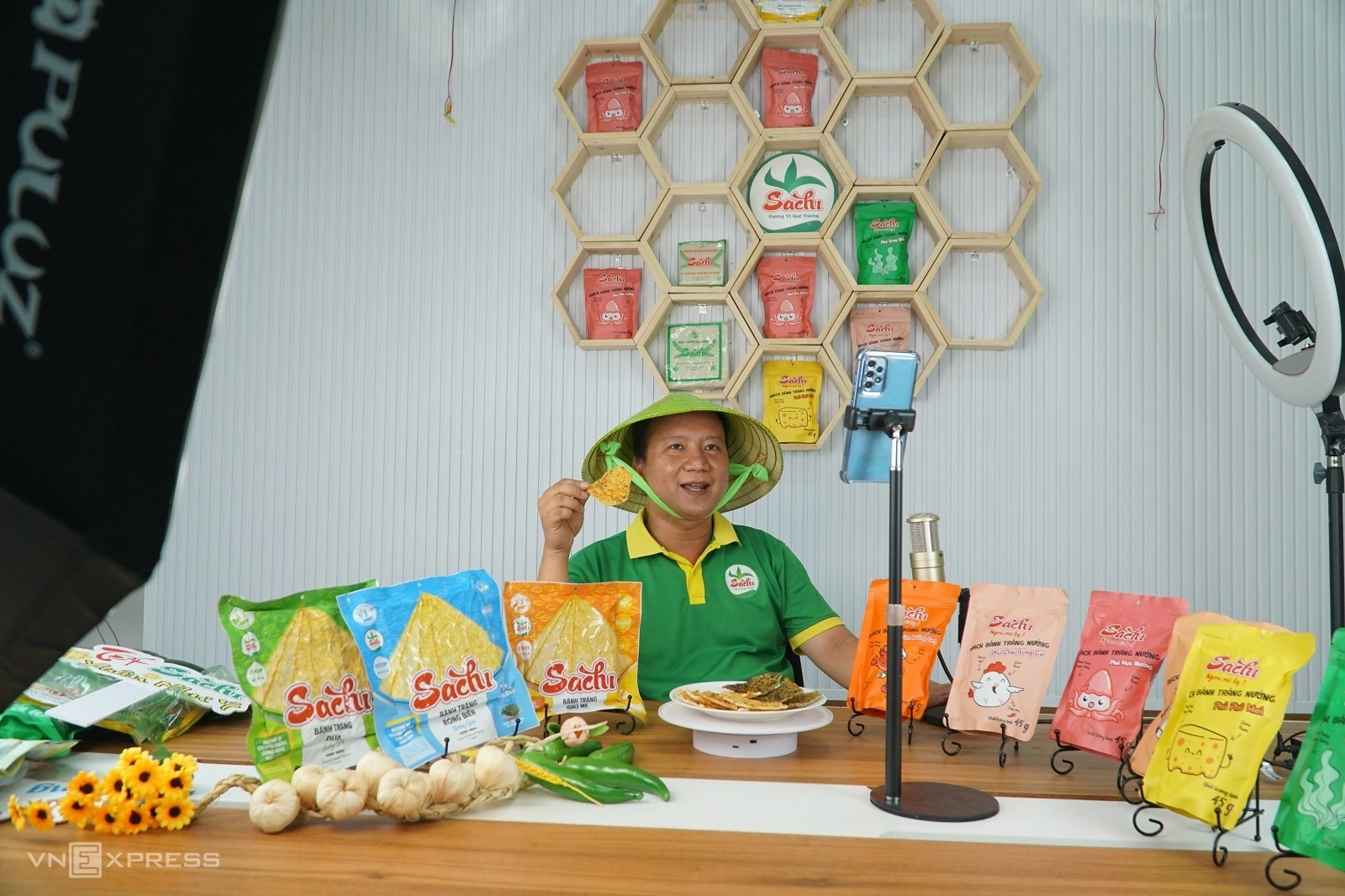
Mr. Nguyen Huu Vinh livestreams at the factory. Photo: Pham Linh
Nguyen Huu Vinh, 36 years old, founder and CEO of Sachi Foods brand in Hoai Nhon town, Binh Dinh province. With a factory of about 2 hectares and a capacity of 5 tons of rice paper per day, Sachi is currently one of the largest rice paper factories in the country. When participating in Shark Tank Vietnam, Sachi was offered by Shark Thai to invest 5 billion to get 10% of the shares but the business owner refused. The 8x CEO shares his entrepreneurial journey with traditional hometown products.
– What made you choose rice paper to start your business?
– My hometown is Tam Quan coconut land, so coconut rice paper, a specialty of this land, has been a familiar part of me since I was a child. When I grew up, I passed the college entrance exam for Automation. After that, I dropped out to study Economics because this major was hot at that time. After graduating, my friends and I started a technology company, then failed, then switched to import and export, and also found that I was not suitable.
After many years of working in the city, I returned to my hometown in 2015 and had no specific direction. My family had a bakery, named after my father – Sau Chien, so I researched and improved the raw material mixer, dryer, cake press… first for my family to make yeast cakes, thuận cakes, sponge cakes and royal sticky rice cakes.
Looking more broadly, I saw that my hometown had many manual cake workshops, people had to spend a lot of effort in many stages that machines could replace, so I started consulting on agricultural machinery. With the knowledge base from studying automation, I invented many machines to serve production. Since 2016, I have invented an economical drying system for agricultural products and specialty cakes, an electric agricultural grain roaster…
At that time, I thought, why don’t I produce these handmade cakes, improve productivity and quality with machines, and enhance the brand? And the most suitable product must be rice paper, because it is what people remember most when talking about Tam Quan. So I started, inheriting the name of my family’s cake workshop, Sau Chien, abbreviated as Sachi. Sachi in Japanese means luck and happiness.
– How is your way of making rice paper different from the traditional method?
– In the countryside, everyone knows the scene of drying rice in the rain, but in Tam Quan, people are used to having to carry a tray of rice paper every time it rains. Making traditional rice paper depends on the weather, sunny days only dry the rice paper, but Sachi’s rice paper does not need to be dried but is dried with steam and infrared technology, so when it rains we can still do it normally, even increasing productivity to meet consumption needs during Tet.
This is just one of the steps that involves machines. In the rice paper spreading stage, I apply steam heat, helping to spread the dough evenly and accurately on the surface. The machine can be programmed to create rice paper with many different shapes such as round, square, triangular depending on the requirements.
In addition, I have developed additional supporting equipment such as baking machines and coconut peeling machines, completing the whole baking line from start to finish. These systems are also integrated with modern IoT technology, allowing users to monitor and manage the production process remotely. Thanks to that, adjusting temperature, time, and other technical parameters becomes easy, helping to improve the efficiency and uniformity of the product.
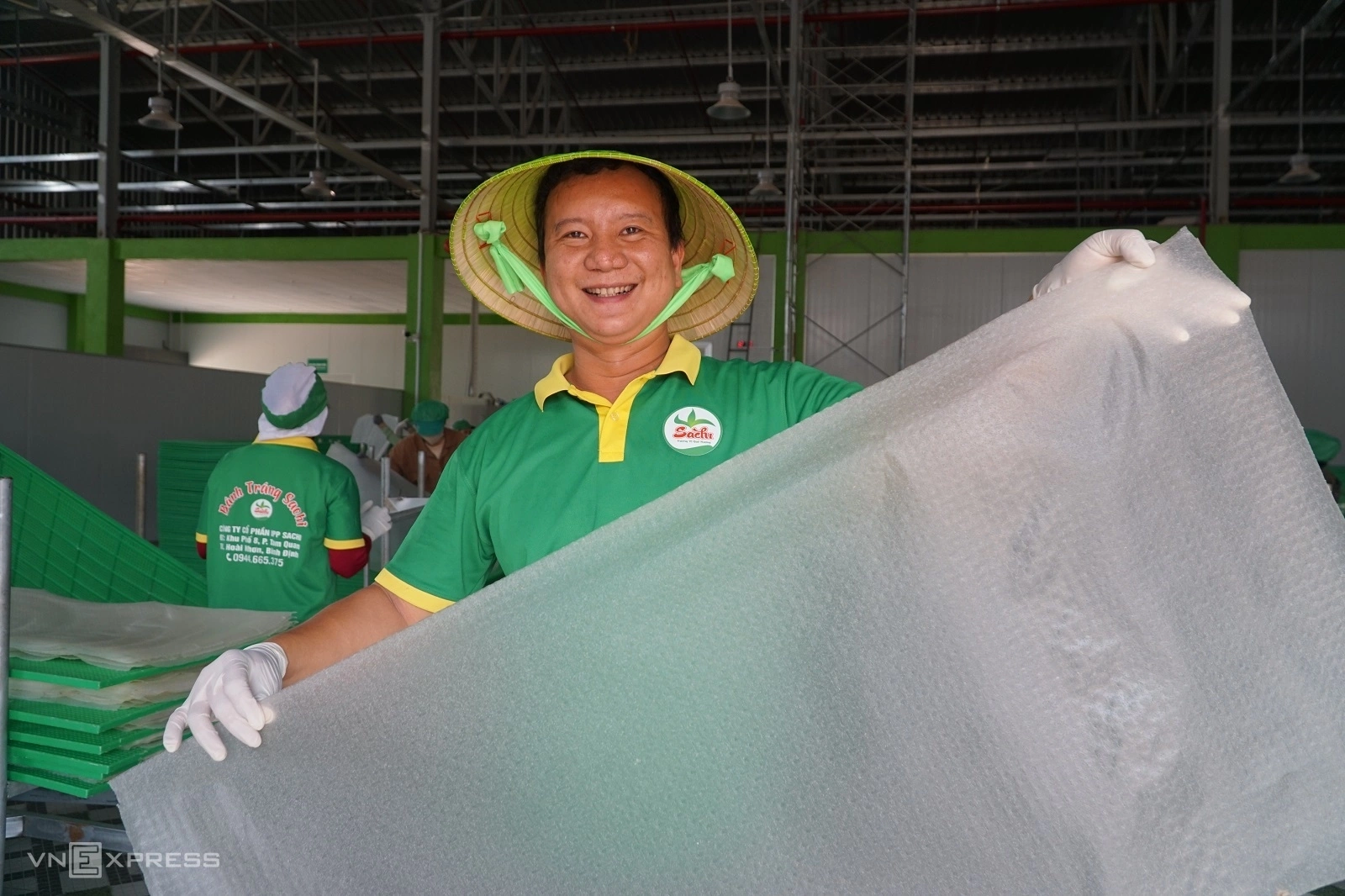
Mr. Nguyen Huu Vinh at the production workshop. Photo: Pham Linh
– Tam Quan rice paper is very familiar, but the flavor rarely changes, so it is difficult to reach young customers. How have you innovated your products?
– Traditional Tam Quan rice paper has two main ingredients: rice, coconut milk and sesame. The cake is very thick and to grill it well, you need crispy charcoal. If the fire does not reach the cake, it will be tough and hard. Therefore, many people in the city who do not have charcoal available will be reluctant to use it
We overcome this disadvantage by pre-baked cakes, put them in vacuum bags. But there is a notion that machine-baked cakes are not as delicious as charcoal, so how can we change this prejudice? I spent a lot of time improving carbon fiber lamps, now the lamps have created a heat radiation wavelength similar to charcoal up to 85%.
In addition, Sachi not only has traditional types such as coconut water rice paper, sesame rice paper, rice paper for rolling; We also blend local products to create a new product line called “rice paper snacks”: such as seaweed rice paper, shredded pork rice paper, cheese-coated rice paper, spicy squid rice paper, fish sauce-dried rice paper… The product lines have new, delicious flavors, are very attractive, very “trendy”, suitable for young people and international guests.
When I realized the similarities between snacks and rice paper, I saw the ability of rice paper to integrate into the culinary tastes of young people and to bridge cultures, so rice paper can be consumed strongly domestically and internationally.